If you are planning a WordPress website, you will soon face this choice: build it with Elementor, or have a developer build a custom theme. Both are popular, both can look great, and both have real downsides. The right answer depends on your budget, how fast you need the site, and how important speed and SEO are to your business.
I have built websites both ways. In fact, my own website started on Elementor and now runs on a custom theme I built from scratch. Here is an honest comparison, without the sales pitch.
What is the difference?
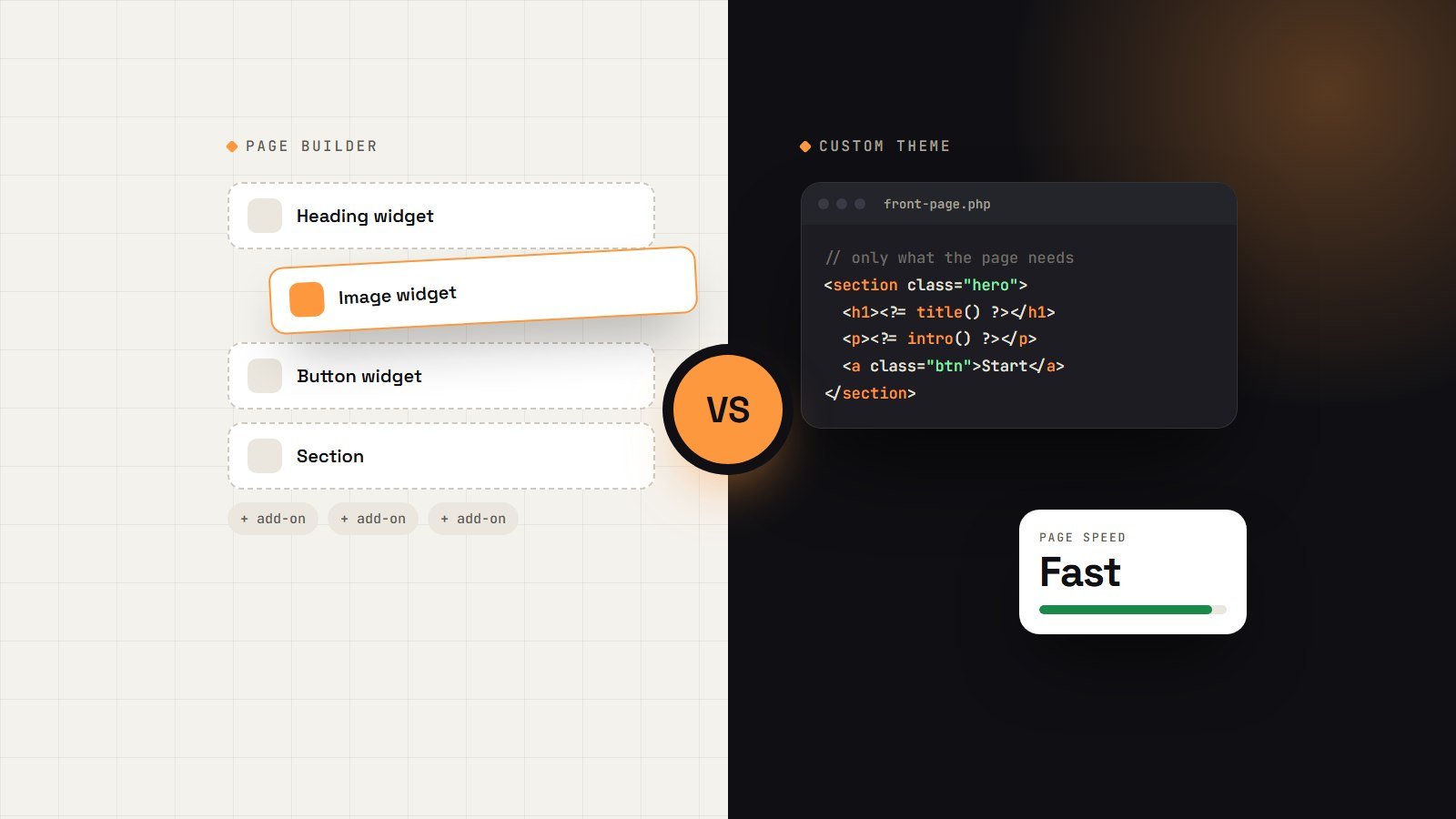
Elementor is a drag-and-drop page builder plugin. You design pages visually by dragging widgets (headings, images, buttons) onto the page. It sits on top of a theme, often a lightweight one such as Hello Elementor.
A custom WordPress theme is code written specifically for your website. The design, layouts and features are built in, and content is edited through normal WordPress fields, so pages stay consistent and there is no page builder adding extra weight.
Quick comparison
| Elementor | Custom theme | |
|---|---|---|
| Upfront cost | Lower | Higher |
| Time to launch | Faster | A little slower |
| Page speed | Often slower (extra code) | Fast (only the code you need) |
| SEO foundation | Good, needs tuning | Excellent when built well |
| Design freedom | High, inside the builder | Unlimited |
| Easy to edit | Yes, but easy to break layouts | Yes, with fixed, safe fields |
| Yearly licence | Elementor Pro is a yearly subscription | None |
| Long-term flexibility | Locked to the builder | Fully yours |
Speed: the biggest difference
Page builders have to support every possible layout, so they load extra CSS, JavaScript and nested HTML on every page, even for features you never use. A simple Elementor page often carries far more code than the same page in a custom theme.
Why does this matter? Visitors leave slow websites, and Google uses page experience signals such as Core Web Vitals when ranking pages. A fast site is not just nicer; it gets more leads from the same traffic.
To be fair, Elementor has improved its performance a lot, and a skilled developer can make an Elementor site reasonably fast with good hosting, caching and careful design. But you are starting from a heavier base, so it takes more work to reach the same result. If your site is already slow, speed optimisation can help a lot either way.
SEO: who wins?
Both can rank. Google does not penalise Elementor. The differences are in the details:
- Clean HTML. Custom themes produce lean, well-structured HTML with correct heading order. Builder layouts often wrap content in many extra layers.
- Speed. As above, faster pages have an edge.
- Structured data. A custom theme can output exactly the schema your business needs (services, reviews, FAQs) instead of relying on extra plugins.
- Consistency. Fixed templates mean every service page has the right title, headings and internal links, so nothing is forgotten.
Editing your own website
This is where Elementor shines. You can change almost anything visually, and you see the result immediately. The downside is that it is also easy to break things: a wrong drag can push a section out of line on mobile, and pages slowly drift into different styles.
A good custom theme takes a different approach. You edit text, images, prices and FAQs in simple fields, and the design stays perfect on every screen. You trade unlimited freedom for safety and consistency, which is exactly what most business owners want.
Cost over time
Elementor is usually cheaper to start with. Over a few years the picture changes:
- Elementor Pro and its add-ons are yearly subscriptions.
- Many Elementor sites end up with extra add-on plugins, each with its own licence and update risk.
- Moving away from a page builder later usually means rebuilding every page.
A custom theme costs more upfront but has no builder licences, fewer plugins to maintain, and no lock-in. For a website you plan to keep for years, the total cost is often similar or lower. I wrote a full breakdown of what a WordPress website costs if you want the numbers.
When Elementor is the right choice
- You need a site live quickly on a small budget.
- You want to design and change page layouts yourself, often.
- The website is a simple brochure or a short-term campaign.
- You are testing an idea before investing more.
When a custom theme is the right choice
- Your website is a main source of leads or sales.
- Speed and Google rankings matter to your business.
- You want a unique design that matches your brand exactly.
- You want staff to update content safely without breaking the layout.
- You plan to grow the site with services, case studies, a blog or automations.
My own experience
My first website was built with Elementor. It looked fine, but it carried a lot of code I never used, and every change meant fighting the builder. When I rebuilt it as a custom theme, the pages became lighter, every service page followed the same SEO-friendly structure, and updating content became simple. For a business website that has to bring in work, I would choose the custom route again.
You can see examples of custom builds in my projects.
FAQs
Is Elementor bad for SEO?
No. Elementor sites can rank well. They just need more care with speed, heading structure and image sizes, because the builder adds extra code.
Can I move my Elementor website to a custom theme?
Yes, but the pages need to be rebuilt in the new theme, because Elementor layouts do not transfer. Your content, images, blog posts and URLs can be kept, with redirects for any address that changes, so you don’t lose rankings.
Is a custom theme harder to edit?
Not if it is built well. You edit content through simple fields and the normal WordPress editor. Many clients find it easier than a page builder because there is nothing to accidentally break.
How much does a custom WordPress theme cost?
It depends on the number of templates and features. My WordPress development projects start from $499, and you always get a fixed quote first.
Not sure which one you need?
Tell me about your business and your goals, and I will recommend the option that fits, even if it is the cheaper one. If you already have an Elementor site, a free website audit will show where it is losing speed and rankings.

Written by Wasiq Khan
Web developer & AI automation specialist helping businesses launch fast websites and automate the busywork.
Work with me